Cloudflare's latest transparency report — covering the first half of 2025 — is now live. As part of our commitment to transparency, Cloudflare publishes such reports twice a year, describing how we handle legal requests for customer information and reports of abuse of our services. Although we’ve been publishing these reports for over 10 years, we’ve continued to adapt our transparency reporting and our commitments to reflect Cloudflare’s growth and changes as a company. Most recently, we made changes to the format of our reports to make them even more comprehensive and understandable.
In general, we try to provide updates on our approach or the requests that we receive in the transparency report itself. To that end, we have some notable updates for the first half of 2025. But our transparency report can only go so far in explaining the numbers.
In this blog post, we’ll do a deeper dive on one topic: Cloudflare’s approach to streaming and claims of copyright violations. Given increased access to AI tools and other systems for abuse, bad actors have become increasingly sophisticated in the way they attempt to abuse systems to stream copyrighted content, often incorporating steps to hide their behavior. We’ve responded by experimenting with new ways to address allegations of streaming and copyright infringement, working closely with rightsholders to better identify domains and accounts that might be streaming to speed up our processes to respond in real time and to better identify possible risks.
This effort aligns with the interests of policymakers, rightsholders, and online service providers in preventing pirated streaming of sporting and other events over the Internet. Indeed, the same actors who infringe legitimate intellectual property rights with unauthorized streaming may seek to misuse Cloudflare’s services, impacting performance, costs, and reliability for other users. This shared interest in identifying and responding to unauthorized streaming has led to opportunities for partnerships and better information sharing. Preventing unauthorized streaming is a hard problem that requires those partnerships, with streamers constantly finding new ways to evade detection and preventive actions.
Innovating to address abuse and identify new threats
With approximately 20% of the web behind Cloudflare’s network, building smart and scalable abuse processes has never been optional. Even as a much smaller company with more limited services, we recognized the importance of creating a system that efficiently got abuse reporting to those best positioned to action the reports, typically the website owner or hosting provider. Our view was that we could play an important role in ensuring that allegations of abuse reported to us went to those entities without compromising their security.
As we have developed new services, we have applied a service-specific approach to abuse, reflecting the nature of the services provided, legal requirements, and human rights considerations. This approach means that we treat hosted content differently than content on websites that use our security and CDN services, an approach reflected throughout our transparency report.
Beyond Cloudflare’s response to individual abuse reports, we also recognize the value of systems that learn from the abuse reports we receive. Not only do efforts to identify abuse patterns improve our ability to detect and mitigate abuse on our network, they enable us to better protect our customers from a wide range of cyber threats.
Rapid developments in AI and constantly improving technologies create new challenges and new opportunities. Bad actors have learned how to use AI to quickly stand up sophisticated phishing campaigns, or shift and divide unauthorized streaming traffic to evade detection. LLMs also enable misuse of abuse reporting systems, facilitating the creation of large volumes of low quality or even malicious abuse reports.
At the same time, the ability to apply machine learning and AI to the reams of traffic and information behind Cloudflare’s network has enabled the development of new tools to detect and mitigate abusive conduct. Cloudflare has created automated systems that can keep up with the scale of the issue, all while more accurately identifying genuine abuse. In 2024, as reflected in the temporary surge in phishing actions reported in our abuse transparency report, Cloudflare expanded the use of automated systems to respond to reports of technical abuse like phishing. Behind the scenes, Cloudflare has taken similar steps to identify new patterns of abusive behavior, to help prevent bad actors from using our services in the first place.
Knowing that bad actors aren’t likely to give up, Cloudflare has continued innovating in 2025. We’re exploring new ways to learn about and respond to abuse, with the goal of identifying and pursuing the strategies with the most promise for long-term impact.
Technical responses to streaming abuse
Cloudflare has always believed that, regardless of their size, websites deserve a secure, fast, reliable web presence. And because we didn’t think you should have to pay for coming under cyberattack, we’ve offered a free plan for websites since Cloudflare launched in 2010. That system — which protects websites around the world from cyberattack for free — works because websites do not consume much bandwidth.
Streaming is different. Every second of a typical video requires as much bandwidth as loading a full webpage. To ensure that we can continue to provide free services, we’ve always restricted use of our free services to deliver streaming video. Although most of our customers respect these limitations and understand the role they play in enabling our ability to provide these services for free, we sometimes have users attempt to misconfigure our service to stream video.
In the first half of 2025, Cloudflare worked with several large rightsholders on efforts to address unauthorized streaming. This included providing rightsholders with an API for streamlined reporting, giving feedback on the quality of reports to ensure rightsholders are giving us actionable information, and, after verifying reports against our own internal metrics, taking steps to respond to streaming reports at scale.
Those efforts bore results, helping us better identify and action unauthorized streaming. The engagement resulted in a significant increase in DMCA reports that Cloudflare received for websites using our hosted services, from approximately 11,000 in the second half of 2024 to approximately 125,000 in the first half of 2025. It also enabled us to speed up our notice and takedown process as we took action in response to 54,000 reports, compared to 1,000 reports in the second half of 2024. Using information from these reports, we identified additional signs of abusive behavior, leading us to terminate hosting services to another 21,000 accounts.
Cloudflare also relied on information provided by rightsholders to bolster our technical tools for preventing unauthorized streaming over Cloudflare’s network by websites using our non-hosted services. To maintain the ability to provide free and low-cost services to static websites, we may take action on websites using those services if they appear to be streaming, regardless of whether that content infringes on copyright. Over the years, we have built a variety of tools to identify and restrict this type of streaming. While rightsholders’ streaming reports are focused on infringement, we can use these reports as signals to help inform our technical tools and improve our response. Working closely with rightsholders has improved our response time on their specific abuse reports and has also helped us prevent thousands of similar websites attempting to stream in an unauthorized manner over our network before they have ever been identified as infringing.
The information about streamer tactics and techniques gleaned from these efforts are useful in our broader cybersecurity efforts. Earlier this year, for example, we used information from our streaming program to help a smaller customer whose services were being abused to host streaming content without their knowledge. Understanding how illegal streamers were accessing and abusing their services enabled us to provide them guidance and tools to prevent the behavior.
While we have made significant progress on this issue, we fully expect that streamers will adjust their behavior in response to the steps we’ve taken. Cloudflare’s work is not done, and we will continue to look for innovative ways to prevent and address this type of abuse.
Addressing blocking demands
Пока Cloudflare сотрудничает с правообладателями над техническими решениями для потоковой передачи, которые решают проблему в реальном времени, многие регуляторы и правообладатели избрали более грубый подход: добиваться законодательно санкционированной блокировки интернета. Недостаток технической экспертизы или простое равнодушие могут привести к значительной избыточной блокировке невиновных веб-сайтов, часто без прозрачности и подотчетности для ответственных сторон. Мы разделяем точку зрения групп гражданского общества, таких как Internet Society, что лучшим и наиболее эффективным подходом остается удаление незаконного контента в источнике.
Одним из самых печально известных примеров избыточной блокировки стали действия испанской футбольной лиги ЛаЛиги. Через интернет-провайдеров в Испании они осуществляли массовую блокировку IP-адресов, используемых тысячами веб-сайтов во время матчей, без какого-либо государственного надзора. Это вызывало серьезные перебои в работе интернета по всей Испании во время матчей. Непропорциональный эффект блокировки IP-адресов хорошо известен. Тем не менее, ЛаЛига не извинилась за блокировку бесчисленного множества несвязанных веб-сайтов, полагая, что их коммерческие интересы должны преобладать над правами испанских интернет-пользователей на доступ к более широкому интернету во время матчей. Хотя такой подход игнорирует устоявшиеся правовые принципы, требующие, чтобы любая блокировка была соразмерна проблеме, правительство Испании не предприняло действий для защиты прав своих интернет-пользователей. На фоне этого явного вреда и нежелания правительства обеспечить достаточный надзор мы не видели конкретных доказательств того, что такие грубые методы блокировки существенно решают проблему.
Cloudflare считает, что регуляторы и правообладатели несут ответственность за поиск соразмерных способов предотвращения нарушений в интернете, и что совместная работа с поставщиками услуг предлагает лучший способ эффективного противодействия злоупотреблениям, не нанося фундаментального ущерба интернету. Как показывает пример ЛаЛиги, блокировка на уровне инфраструктуры часто является избыточно широкой, непрозрачной и неэффективной.
Хотя у нас есть серьезные опасения по поводу блокировок, и особенно того, как правообладатели используют их для продвижения своих коммерческих интересов в ущерб правам обычных интернет-пользователей на доступ к законному контенту, Cloudflare изучила способы, которыми блокировка могла бы применяться как более целенаправленная или соразмерная мера. В целом Cloudflare пришла к выводу, что эффективность блокировки ограничена, поскольку целеустремленные пользователи найдут способы обойти ограничения. Тем не менее, Cloudflare предприняла шаги для выполнения законных распоряжений, касающихся наших CDN-сервисов, которые соответствуют принципам прав человека, относящимся к соразмерности, должной правовой процедуре, свободе выражения и прозрачности. В странах, законы которых предусматривают блокировку доступа к онлайн-контенту и обеспечивают соответствующий надзор, Cloudflare может применять геоблокировку веб-сайтов, чтобы ограничить доступ к ним через CDN-сервисы Cloudflare на соответствующей юрисдикции.
Cloudflare никогда не блокировала через наш публичный DNS-резолвер. Как мы уже описывали, мы считаем, что требования блокировать через публичный DNS противоречат стремлению к открытому интернету и потребовали бы создания новых инструментов, идущих вразрез с архитектурой нашего резолвера. Мы продолжаем оспаривать в суде попытки обязать нас создавать такие возможности. Cloudflare иногда предпринимала действия по геоблокировке доступа к веб-сайтам через свои CDN- и сервисы безопасности в ответ на судебные предписания о блокировке DNS.
В первой половине 2025 года Cloudflare зафиксировала заметный рост числа получаемых в Европе предписаний о блокировке. Частные правообладатели получили несколько судебных предписаний, обязывающих Cloudflare заблокировать доступ к веб-сайтам в Бельгии, Франции и Италии. Хотя Cloudflare оспорила некоторые аспекты этих предписаний, мы предприняли шаги для их выполнения, применив геоблокировку доступа к соответствующим веб-сайтам в указанных странах через наши CDN- и сервисы безопасности.
Cloudflare также начала исполнять решения судов Великобритании, обязывающие других поставщиков услуг блокировать веб-сайты, признанные посвященными нарушению авторских прав. На основе добровольного соглашения с правообладателями Cloudflare применяет геоблокировку веб-сайтов, подпадающих под эти предписания, через наши pass-through CDN- и сервисы безопасности. Когда мы принимаем меры в отношении доменов на основании этих предписаний, мы показываем промежуточную страницу, которая возвращает код состояния 451 и направляет посетителя к конкретному судебному предписанию, которое включает процедуру для затронутых сторон оспорить блокировку.
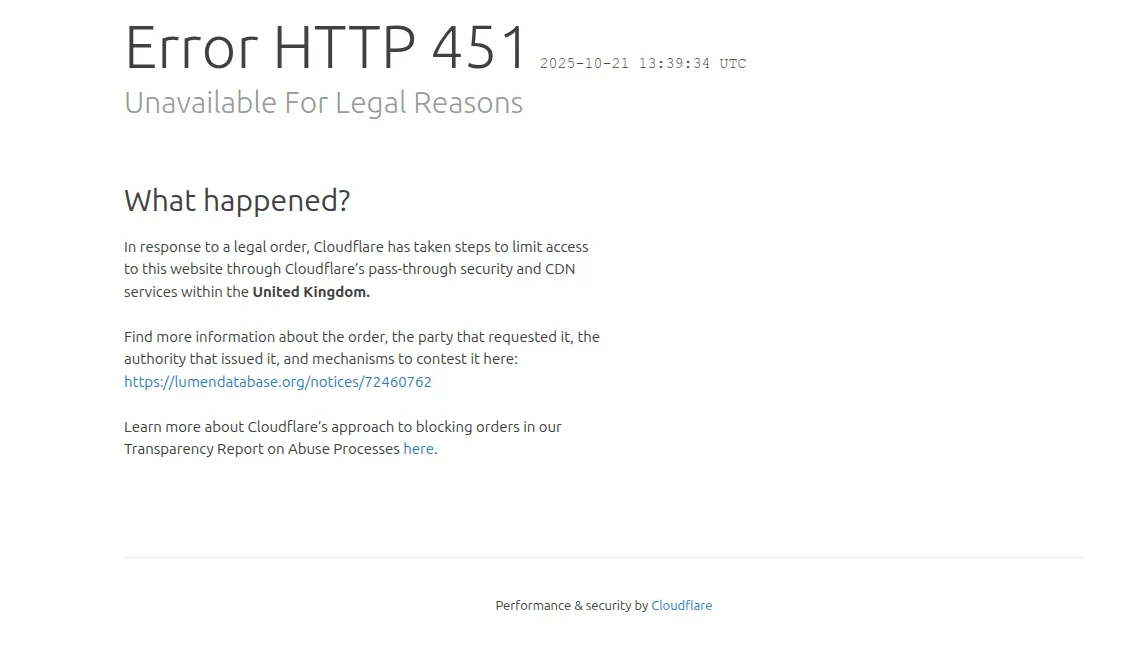
Пример страницы с ошибкой 451 в Великобритании.
Наши усилия в Великобритании по блокировке контента на основании установленного в предписании, адресованном третьей стороне, факта нарушения отражают наше желание опробовать более целенаправленные подходы по сравнению с избыточной блокировкой, которую мы наблюдали в других странах Европы, а также наше понимание, что режим Великобритании включает важные гарантии в отношении соразмерности, должной правовой процедуры и прозрачности, включая возможность для затронутых сторон добиваться восстановления прав. В настоящее время мы отслеживаем влияние этого подхода и предприняли эти шаги с пониманием, что можем изменить курс, если увидим злоупотребление системой.
Наконец, в первой половине 2025 года мы наблюдали расширение сфер, в которых требуется блокировка. Мы получили официальные уведомления правительств Франции и Бельгии о том, что веб-сайты, использующие наши хостинговые услуги, незаконно предлагали азартные игры на этих юрисдикциях. В обоих случаях мы смогли передать уведомление нашему клиенту, и он самостоятельно принял меры для его устранения. Это иллюстрирует преимущество прямой связи нашего клиента с государственным регулятором, чтобы он мог решить проблемы со своими веб-сайтами, вместо того чтобы сразу переходить к требованию о блокировке.